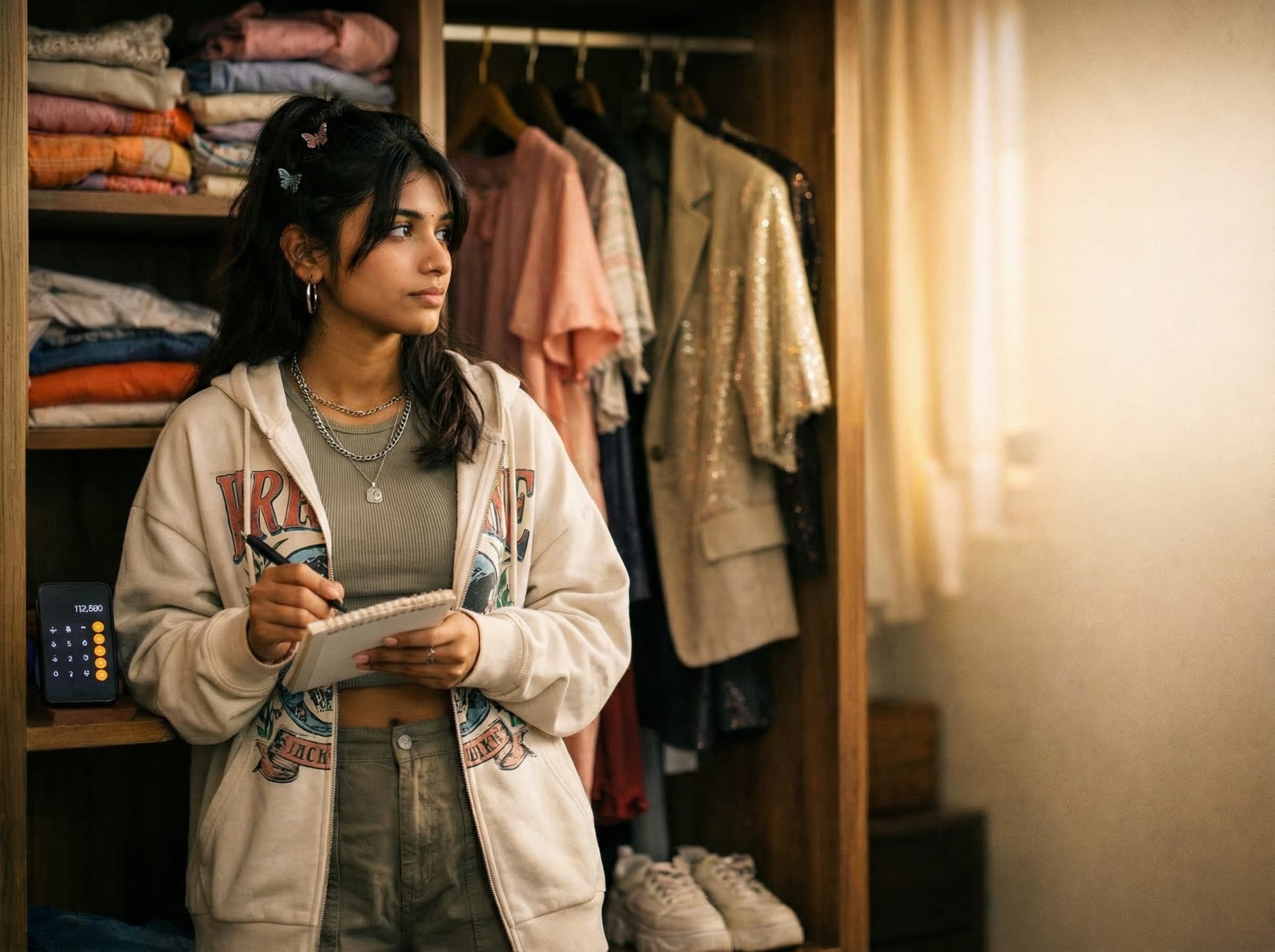
You've spent close to ₹80,000 on clothes in the last two years. Your cupboard is bursting at the hinges. There's a Myntra bag you never fully unpacked from last EORS sitting in the corner. And yet — every Monday morning, you stand in front of that cupboard in your towel and genuinely feel like you have nothing to wear.
That's not a shopping problem. That's a strategy problem.
₹1 lakh is a real, achievable number for a metro professional. Not a fantasy, not a flex — just one year of intentional spending instead of impulse buying. The question isn't whether you can spend it. The question is whether you can make it work.
Why Metro India Makes This Harder Than It Looks
India's apparel market is now worth over USD 115 billion, with 800+ homegrown D2C brands launching in the last decade alone. Myntra, Ajio, Nykaa Fashion, Zara, and H&M are all competing for your attention every single day. Flash sales, "last 2 left" nudges, Insta reels showing a ₹1,200 top styled four ways — the ecosystem is designed to make you buy impulsively.
Gen Z and millennial metro women shop more frequently than any previous generation. Most are building their wardrobes ₹499 at a time — and those ₹499 pieces cost more than they appear. That EORS haul where you spent ₹28,000 and wore maybe 40% of it? That's ₹16,800 sitting in your cupboard with the tags on.
The ₹1 lakh wardrobe this guide is about is the opposite of that. It's built slowly, on purpose, with one goal: every single piece earns its place.
The Metro India Wardrobe Challenge Is Unlike Anywhere Else
Most capsule wardrobe guides are written for London or New York. They assume one climate, one dress code, and maybe two occasions. Your life as a metro Indian woman is far more complicated — and far more interesting.
Your climate is non-negotiable
Mumbai humidity destroys synthetic fabrics by April. Delhi summers demand cotton that breathes. Bengaluru's pleasant weather is deceptive — it gives you flexibility, and flexibility without discipline becomes a wardrobe disaster. Whatever city you're in, your clothes have to survive here. Instagram looks don't account for auto rides in 38-degree heat.
You live across at least four wardrobes simultaneously
Office and professional. Casual urban — weekends, brunches, that rooftop thing on Saturday. Festive and ethnic — Diwali, two cousins' weddings this year, office pooja. Active and travel — gym, that Coorg trip, the airport run at 5 AM. Most people accidentally build for only one or two of these and panic-buy for the rest.
The shaadi season panic is real
Every metro woman knows this feeling: it's October, your cousin's engagement is in three weeks, you have nothing to wear, and you end up spending ₹12,000 on a lehenga set you'll wear once because you ran out of time to plan. The ₹1 lakh wardrobe solves this in advance.
Maahu is being built for exactly this — borrow for the one-off, own the investment pieces. Join the founding squad.
Join the waitlist →The Framework That Changes Everything: Cost-Per-Wear
Before you allocate a single rupee, you need to internalize one idea: the expensive piece you wear 100 times is cheaper than the cheap piece you wear twice.
This is the cost-per-wear calculation, and it completely flips how you think about fashion spending.
| Item | Price | Times Worn | Cost Per Wear |
|---|---|---|---|
| Zudio trend top | ₹799 | 4 | ₹200 |
| Fabindia cotton kurta | ₹2,200 | 80 | ₹27 |
| Levi's 511 denim | ₹3,999 | 150 | ₹26 |
| Zara blazer | ₹7,990 | 60 | ₹133 |
| Van Heusen formal shirt | ₹1,799 | 100 | ₹18 |
The goal of a ₹1 lakh wardrobe is to push your average cost-per-wear as low as possible — which means investing heavily in versatile, high-wear pieces and being ruthless about trend-driven impulse buys.
"The expensive piece you wear 100 times is cheaper than the cheap piece you wear twice."
The ₹1 Lakh Blueprint: Where Every Rupee Goes
Here's how to split the budget across five categories. These numbers are for a working woman in a metro city — adjust the professional versus casual split based on your actual life.
Your highest cost-per-wear pieces. The backbone. They work across occasions, survive multiple seasons, and make everything else in your wardrobe work harder.
- 5–6 premium cotton or linen kurtas and shirts (₹1,800–₹3,500 each) — Fabindia, AND, W for Woman. Natural fabrics only. Polyester in Indian heat is a form of self-harm.
- 2 pairs of well-cut trousers or straight-leg jeans (₹3,500–₹5,000) — Levi's for denim, Van Heusen or AND for trousers
- 2–3 quality neutral t-shirts — H&M basics or Uniqlo if you have access
- 1 great dark-wash denim — your hardest-working item. Dress up with a blazer, dress down with a tee.
Nothing goes in this category unless it works with at least four other things you already own.
Most people underspend here and then overspend on something last-minute before a big presentation.
- 1 versatile blazer (₹6,000–₹9,000) — Navy, charcoal, or warm beige from Zara, Mango, or AND. This one piece transforms a casual outfit into a professional one in 10 seconds.
- 3–4 office-ready tops or shirts (₹1,800–₹2,500 each) — AND and W for Woman are the most reliable for contemporary workwear that doesn't look like a uniform
- 1 pair of tailored trousers or a structured midi skirt (₹3,000–₹4,500)
If you're a metro Indian woman without a solid ethnic core, you are one wedding invitation away from a financial emergency.
- 2–3 quality kurta sets (₹3,000–₹5,000 each) — Fabindia for everyday ethnic. BIBA for affordable occasion wear. Global Desi or AND for fusion silhouettes that work at office Diwali and a casual family dinner equally.
- 1 investment ethnic piece (₹8,000–₹12,000) — A silk kurta, an embroidered co-ord set, or a versatile lehenga skirt you'll rewear for the next five years. Buy once, buy right.
The category where most wardrobes quietly fall apart. You can own the best outfit in the room and kill it entirely with the wrong bag or scuffed shoes.
- 1 pair of versatile block heels or leather flats (₹4,000–₹6,000) — Clarks, Aldo, or Metro Shoes
- 1 pair of clean white sneakers (₹3,000–₹5,000) — Nike, Adidas, or Puma
- 1 pair of ethnic kolhapuris or juttis (₹1,500–₹2,500)
- 1 quality structured tote or everyday bag (₹4,500–₹7,000) — This item appears in every photo, every meeting, every outing. Don't cheap out here.
- Scarves, belts, and 2–3 pieces of statement ethnic jewellery (₹2,000–₹3,000)
This is your permission to follow fashion — but with discipline.
- 3–4 trend pieces per season (₹800–₹2,000 each) from H&M, Zudio, or Zara — buy without guilt, cycle out. The only category where cost-per-wear doesn't need to be perfect.
- Activewear (₹5,000–₹7,000) — Decathlon is the most honest value in India for women's activewear, full stop.
The Brand Cheat Sheet for Metro India Women
| What You Need | Go-To Brands | Price Range |
|---|---|---|
| Everyday ethnic | Fabindia, BIBA | ₹1,500–₹4,000 |
| Fusion / indo-western | AND, W for Woman, Global Desi | ₹1,800–₹4,500 |
| Quality workwear | AND, Vero Moda | ₹2,000–₹5,000 |
| Trend-led western | Zara, H&M | ₹1,000–₹8,000 |
| Wardrobe basics | Fabindia, H&M | ₹800–₹3,000 |
| Value fashion | Zudio, Max Fashion | ₹399–₹1,500 |
| Activewear | Decathlon, Adidas | ₹1,000–₹4,000 |
| Wedding / festive | Fabindia, Anita Dongre | ₹3,500–₹15,000+ |
| Shoes | Clarks, Metro, Aldo | ₹3,000–₹8,000 |
Five Rules to Make ₹1 Lakh Actually Work
Natural fabrics are not optional in India. Cotton, linen, silk. That's it for your foundation pieces. Polyester might look fine in the store in January. By May in Bombay you will regret every synthetic purchase. Fabindia, AND, and Uniqlo lead with natural fabrics. In fast fashion, check the label before you swipe.
If it only works with one outfit, it doesn't belong. Every piece must answer: "What else do I wear you with?" Minimum three pairings. If you can't think of three on the spot, you're buying a costume, not a wardrobe piece.
Invest in your ethnic anchor, rent or borrow for the one-off. One great silk kurta or embroidered co-ord set will outlast seven trend-season lehengas. For that one sangeet or cousin's destination wedding — rent or borrow. Don't blow your ethnic budget on occasions that happen once.
Run the cost-per-wear maths before every purchase. Take 10 seconds. ₹X divided by how many times you'll actually wear this. If the number is above ₹200 for a foundation piece, walk away. Trend pieces get more slack — that's what the ₹15,000 category is for.
Pre-Diwali audit. Pre-summer audit. No exceptions. Sit with your wardrobe twice a year. Pull out what you haven't worn in six months. Sell it on Poshmark India or give it away. The space you create — physical and mental — is what allows intentional buying to replace impulse buying.
What ₹1 Lakh Can't Do
₹1 lakh is a meaningful investment, not a luxury budget. It will not get you Sabyasachi, Tarun Tahiliani, or a designer bag. It should not be stretched into those categories.
What it will get you is a wardrobe that has an intelligent answer for every occasion your metro life demands — office, casual, festive, active — built from natural fabrics, anchored in versatile investment pieces, and leaving you enough runway to follow trends without losing your mind or your savings.
"The metric for success isn't how much you spent. It's how often you open your cupboard and immediately know what to wear."
That feeling? That's what ₹1 lakh, spent right, actually buys you.
Maahu is building the community where you invest in the pieces worth owning — and borrow the rest. Mumbai first.
Join the founding squad →