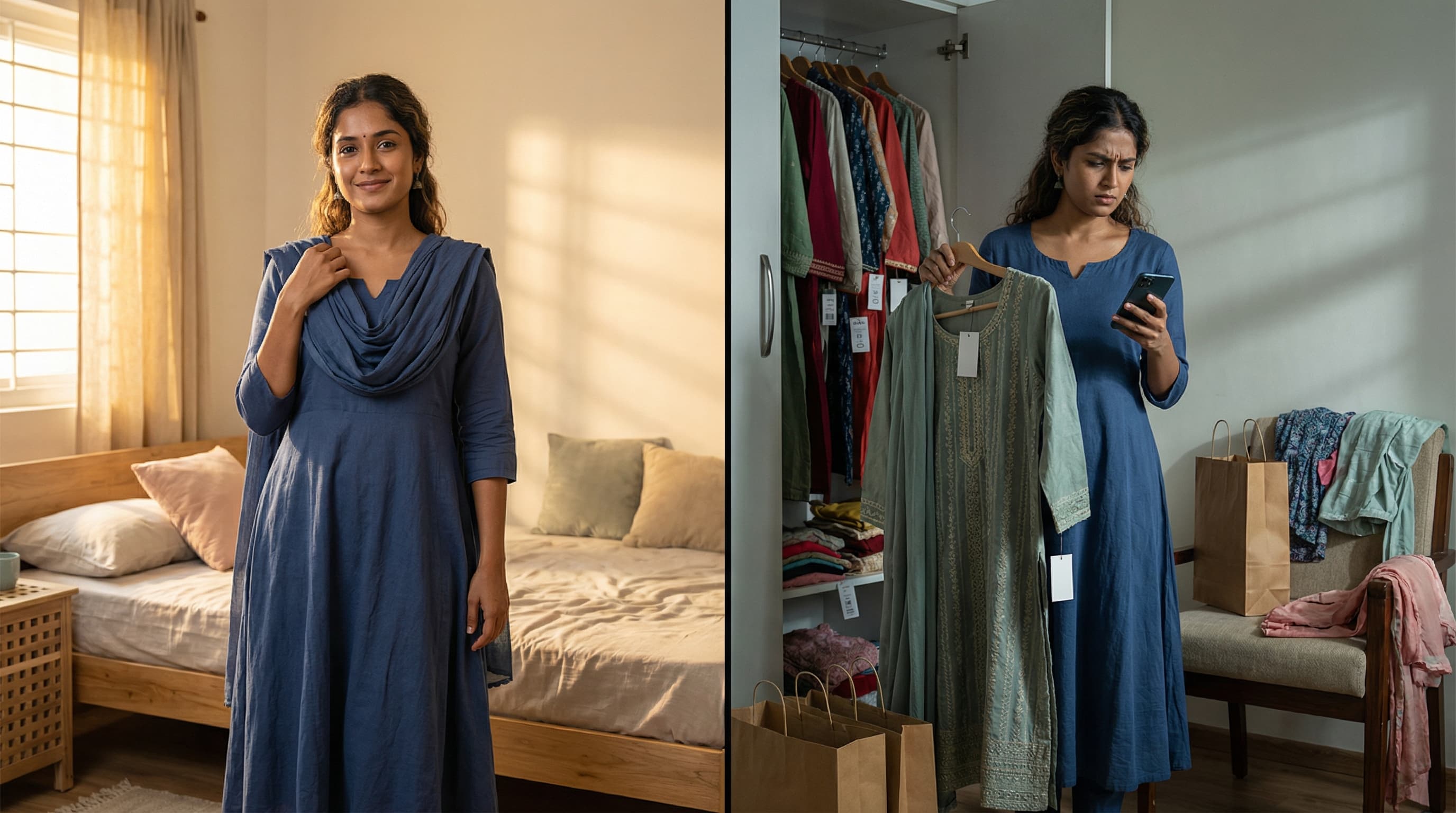
She said it at a cousin's wedding in Defence Colony, standing near the dessert table with the confidence of someone delivering a verdict. 'Yeh toh tune pehle bhi pehna tha.' You wore this before.
That comment — five words, zero malice intended, maximum financial damage delivered — sent me to DLF Promenade the following week. I spent ₹8,500 on an outfit I wore once and have not touched since. The original anarkali she commented on? I've worn it eleven times. Its cost per wear is ₹590. The replacement I bought out of embarrassment? ₹8,500 per wear.
I have been calculating what outfit repeat stigma actually costs Indian women. Across weddings, office parties, festive occasions, birthday dinners, and destination functions. The number, when you add it up honestly, is somewhere between ₹43,000 and ₹1,00,000 per year for an average urban Indian woman. Not on clothes she loves. Specifically on clothes she buys to avoid being seen in the same thing twice.
Nobody has calculated this number for Indian women before. This blog does.
What Is Outfit Repeat Stigma — and Why India Has a Uniquely Expensive Version of It
Outfit repeat stigma is the social pressure to wear a new or different outfit each time you are photographed or seen at a social occasion. It exists everywhere — but India has a version of it that is more expensive than almost anywhere else in the world, for three specific reasons.
First, the occasion density. The average Indian wedding now has 4.2 functions — mehendi, sangeet, wedding, reception — each requiring a different outfit, each photographed extensively, all shared on the same family WhatsApp group within hours. A single wedding season can mean 8 to 15 separate occasion dressing moments across three or four events.
Second, the social circle overlap. Indian social life runs in tight, overlapping circles — family, college friends, work colleagues, building society, kitty party group. The same 30 to 50 people see you at multiple occasions through the year. In an urban Indian context, all of them are photographing everything.
Third, the documentation culture. Every Indian occasion is photographed, videographed, and shared within hours. Instagram posts, WhatsApp forwards, family albums on Google Photos. The outfit is on record within the hour. It is searchable, scrollable, and comparable across events.
Indian weddings now average 4.2 functions per event. 63% of Indian brides changed into a different outfit for each wedding function in 2024. The Indian wedding apparel market drives ₹10,000 crore in annual spending — with women's wear accounting for 70–75% of the total.
WedMeGood / Wright Research, 2024 · WeddingWire India, 2024 · Jefferies India, 2024The outfit repeat stigma is not irrational. The social pressure is real. The photographs are permanent. What is irrational is the financial response to it. Buying ₹8,500 worth of 'never again' to avoid a five-word comment is not a fashion decision. It is a fear decision. And fear decisions have a running annual cost that most Indian women have never added up.
The Real Annual Cost of Outfit Repeat Stigma — Calculated for the First Time
I built this table by mapping the occasions where outfit repeat pressure is highest for an urban Indian woman, the typical spend per occasion driven by that pressure, and the honest number of times that outfit gets worn after the event.
| Occasion | Events/Year | Avg Spend | Times Worn | Annual Cost |
|---|---|---|---|---|
| Wedding guest outfit | 3–4 | ₹6,000–12,000 | 1–2 times | ₹18,000–48,000 |
| Sangeet / Mehendi | 2–3 | ₹3,000–6,000 | 1 time | ₹6,000–18,000 |
| Office festive / Diwali party | 2 | ₹2,500–5,000 | 1 time | ₹5,000–10,000 |
| Birthday dinners / NYE | 3–4 | ₹2,000–4,000 | 1 time | ₹6,000–16,000 |
| Destination functions | 1 | ₹8,000–8,000 | 1–2 times | ₹8,000 |
| Total annual fear tax | — | — | — | ₹43,000–₹1,00,000 |
Read that bottom line again. ₹43,000 to ₹1,00,000 per year. On outfits worn once. That is not a wardrobe. That is a fear tax — paid annually, invisibly, without anyone ever naming it as what it is.
"At ₹43,000 per year invested at 7% FD rate — that is ₹3,010 in interest every year. Over ten years of working life it is ₹6 lakh in opportunity cost. Before compounding."
Where Outfit Repeat Stigma Comes From — and Why It Hits Indian Women Hardest
The stigma is not new and it is not Indian in origin. It has been built and reinforced over decades by a specific set of cultural forces — and Indian women are caught at the intersection of all of them simultaneously.
Television and film built the original template. Decades of Bollywood heroines in a new outfit every scene. TV characters whose wardrobes refresh with every episode. The women we were shown as aspirational never repeated. We absorbed that standard before we had a single rupee of our own to spend.
Social media extended the documentation to real life. What used to apply only to celebrities now applies to every woman with an Instagram account. The pressure to post a new look converted the celebrity standard into a personal expectation.
49% of people globally report feeling self-conscious about repeating outfits at work or social occasions. For Indian women specifically, the combination of dense occasion calendars, overlapping social circles, and instant WhatsApp documentation creates a repeat anxiety that is more financially damaging than in most other cultures.
Business of Fashion / Good On You consumer survey, 2023The most honest thing I can say about this: the stigma is a manufactured problem with a real financial cost. Our mothers rewore sarees to every occasion without a second thought — because there were no WhatsApp groups comparing photos, and because the culture of their wardrobes was built around quality pieces worn repeatedly, not disposable volume bought in panic.
Maahu is building a community where your existing wardrobe does the work — shared, borrowed, reworn without judgment.
Join the waitlist →How to Rewear Without Repeating — Three Tools That Actually Work
The solution to outfit repeat stigma is not 'stop caring what people think.' That is not practical and it ignores the genuine social reality of Indian occasions. The solution is to rewear strategically — in ways that make the outfit feel new even when the piece is not.
Change one significant element
The same anarkali worn with different jewellery, a different dupatta, or a different blouse reads as a new outfit to 80% of the room. The piece is the same. The look is different. The cost per wear drops with every time you do this.
Respect the circle boundary
The outfit you wore to your college friend's wedding can be reworn to your office colleague's wedding without anyone overlapping. Map your circles honestly and repeat across them freely. Indian social circles feel tight but they are not completely the same group.
Borrow the statement piece, own the base
The outfit that gets photographed is usually the statement — the embellished jacket, the bold dupatta, the unusual colour. Own the base. Borrow the element that changes the entire look. It costs you nothing and the photograph looks completely different.
The Real Question Is Not Whether to Repeat — It's Why We Were Taught Not To
Here is the thing about outfit repeat stigma that nobody says plainly: it is not a fashion problem. It is a financial extraction mechanism that was built into Indian women's social culture without anyone naming it as such.
The fast fashion industry profits every time a woman buys something to avoid a repeat. The wedding industry profits from the norm that each function requires a new outfit. Social media profits from the content that new outfits generate. Every rupee of that ₹43,000 annual fear tax flows somewhere — just not to the woman spending it.
Rewearing is not a compromise. It is not 'making do.' It is the financially intelligent, environmentally honest, and — if we're being direct — more stylish approach to dressing. The most elegant women I have ever met own fewer things and wear them more. They are not repeating because they can't afford new. They are repeating because they have the confidence that comes from knowing exactly what works on them.
The Indian wedding industry is valued at $130 billion annually — India's fourth-largest industry. Apparel alone drives ₹10,000 crore in wedding-related spending each season. The pressure to buy new for every function is not organic social culture. It is an economy that runs on the fear of repetition.
Jefferies India, 2024 · Kotak MF / CAIT industry analysis, 2024