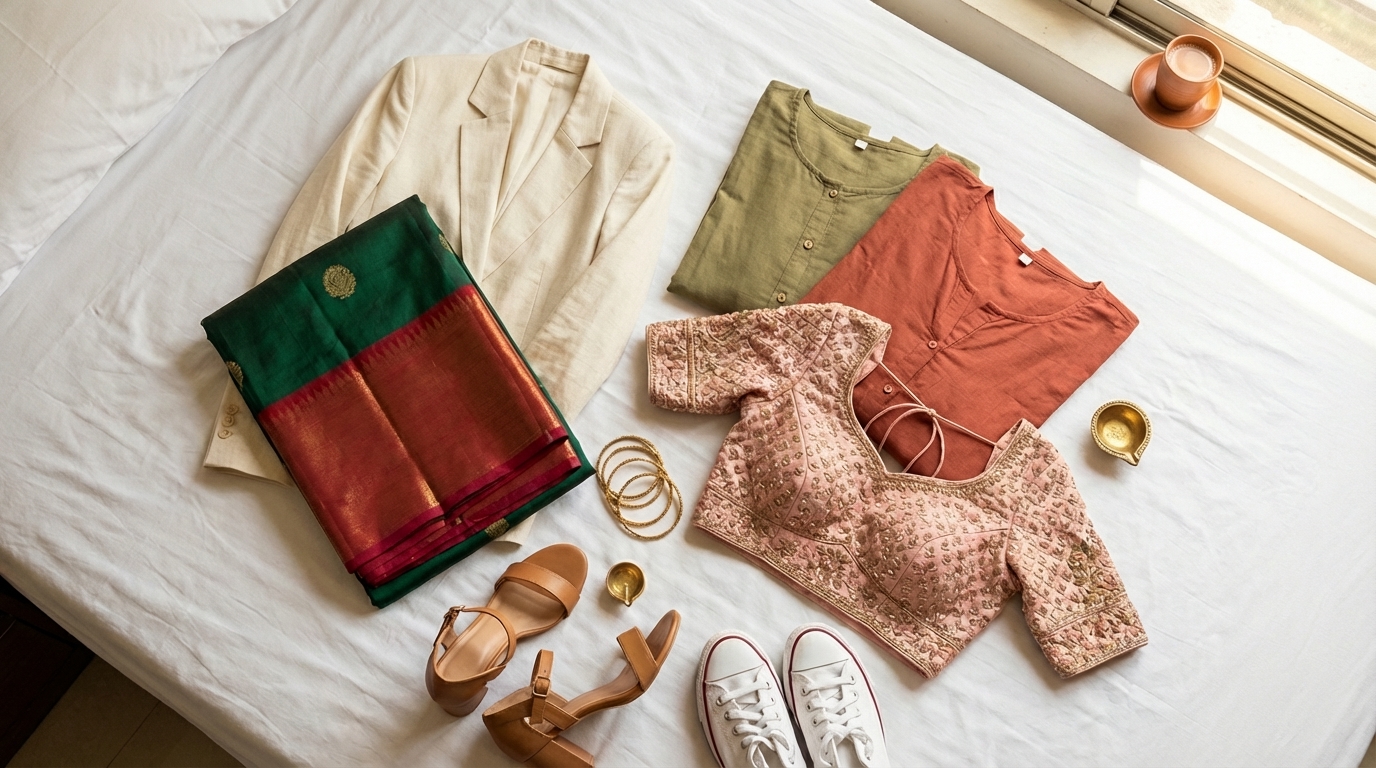
Last Diwali, I was back in Mumbai when Himani called me in a panic. She had three weddings in six weeks and nothing to wear — or so she thought. I told her: before you buy a single thing, let's audit what you already own. She laughed. Then she agreed.
We spent a Sunday afternoon on her bedroom floor in Bandra pulling everything out. Every lehenga. Every kurta bought for "some occasion." Every blazer purchased with the best of intentions. By the time we finished, her room looked like a FabIndia store had exploded.
I photographed each piece and did the maths. The number that came back stopped us both cold: ₹3,10,000. Sitting there. Folded. Mostly unworn. Himani didn't need to go shopping. She needed to meet her own wardrobe.
What Is Closet Worth — and Why It Matters
Closet worth is the estimated current value of everything you own in your wardrobe — not what you paid for it, but what it's actually worth today in resale or rental terms.
It's calculated using three numbers: original purchase price, number of times worn, and current market value if lent or resold. Most women have never done this calculation. I hadn't either. Once I did, I stopped thinking about clothes as expenses and started seeing them as assets with utilisation rates — some earning their place, most sitting completely idle.
Clothing, bedding & footwear accounts for 6.63% of the average urban Indian household's monthly per capita expenditure. With urban MPCE at ₹6,459 in 2022-23, that's over ₹5,100 per person per year spent on clothes — and a large share of it is worn once or twice, then forgotten.
NSSO Household Consumption Expenditure Survey (HCES), MoSPI, 2022-23Over ten years, that's easily a ₹1–5 lakh wardrobe. Almost none of it tracked. Almost none of it working.
If you've been meaning to do this yourself — Maahu is building the tool. Your closet could be doing more.
Join the waitlist →How I Actually Calculated My Wardrobe's Value
The first instinct is to add up what you paid. That's the wrong number — purchase price is sunk cost. What I needed was current value: what each piece is worth on the market today, and what it cost me per wear.
I built a simple three-column spreadsheet: purchase price, times worn, current resale or lending value. The third column is the one that changes everything.
| Item | Purchase Price | Times Worn | Cost Per Wear |
|---|---|---|---|
| Anita Dongre Kurta Set | ₹14,000 | 2 | ₹7,000 |
| Nicobar Cotton Co-ord | ₹3,500 | 30 | ₹117 |
| Bodycon Party Dress | ₹8,000 | 1 | ₹8,000 |
| Kanjeevaram Saree | ₹22,000 | 8 | ₹2,750 |
The most expensive pieces weren't always the worst decisions. The real damage was done by pieces worn once or twice — the occasion dress, the 'this will be perfect for something' kurta, the wedding guest outfit bought in a panic. Those are the ones that silently destroy your cost-per-wear average.
"The difference between a good clothing decision and a bad one isn't the price tag. It's how many times you actually wear it."
The Three Types of Clothing Assets in Every Indian Wardrobe
After the audit, every piece in my cupboard fell into one of three categories. Understanding which is which changes how you care for things, what you buy next, and what you do with what you already own.
1. Heritage Textiles — Hold or Appreciate in Value
This is the category most Indian women are sitting on without realising it. Kanjeevaram silk, Banarasi weaves, Kutch embroidery, Chanderi — these pieces behave almost like collectible assets. My Kanjeevaram purchased for ₹22,000 in 2019 would fetch ₹32,000+ today. Weavers' wages have risen. Raw silk prices have moved. The market knows it, even if we don't.
These are the pieces that deserve proper storage — muslin covers, silica gel, actual care. They earn it.
2. Designer Staples — Strong Rental and Resale Value
A cream linen blazer from a Kala Ghoda boutique. A structured navy kurta that works for a client meeting and a Sunday brunch both. These pieces hold value because they're versatile — someone else can wear them without feeling like they're in costume. They lend well, they resell well, and they carry their weight across years.
This is the category I want more of and actively look for now. Classic silhouettes. Neutral palette. Indian designer, not fast fashion.
3. Fast Fashion and Occasion Wear — Where Money Goes to Die
Trend-driven party dresses. Heavily embellished one-time shaadi outfits. The ₹8,000 bodycon I wore to one rooftop party in 2022 and haven't touched since. High purchase price, terrible cost-per-wear, no secondhand appetite whatsoever.
These aren't assets. They're lessons. And the lesson most of us learn too slowly is that buying more of this category is the one financial decision you can reverse — by just stopping.
India's second-hand apparel market was valued at approximately $3 billion (around ₹25,000 crore) in 2023, and is projected to reach $9.1 billion by 2032 at a 13% CAGR. Women's apparel is the largest segment. The demand for what's sitting in your cupboard already exists.
Credence Research, India Second-Hand Apparel Market Report, 2024₹3,10,000 in Fabric Is ₹21,700 in Lost Interest Every Year
₹3,10,000 sitting idle in a cupboard is an asset with zero yield. A fixed deposit at 7% on that amount would have generated roughly ₹21,700 in interest this year. My wardrobe generated exactly nothing.
That's the real reframe: it isn't money gone. It's money that was converted into an asset and then abandoned. Unlike a bad stock, this one is recoverable. The silk is still silk. The structured pieces are still wearable. The question is what happens next.
We talk about gold investments, property, SIPs — we have entire family conversations about where to park ₹3 lakh. Nobody talks about the ₹2–5 lakh sitting folded in the average urban Indian woman's cupboard, doing nothing. That silence is what Maahu is here to break.
What I Did After the Audit
After the audit, I moved my heritage pieces into proper storage immediately. Muslin covers, silica gel, better care. These are the ones worth protecting.
Then I messaged three friends. Not to sell anything — to swap. I had an Anita Dongre set that would look incredible on my friend Sana for her office party. She had a Raw Mango I'd been eyeing since her sister's wedding. We met over chai, swapped for the season, and both walked away feeling like we'd gone shopping for free.
The bigger shift was at the point of purchase. I stopped asking 'will I wear this?' — we always say yes — and started asking: how many times will I realistically wear this in the next 12 months? If the answer is once, the cost-per-wear maths makes the decision for you. Most impulse buys fail that test. Shaadi season buys almost always fail it.
"Stop asking 'will I wear this?' Ask 'how many times will I wear this in the next 12 months?' If the answer is once — the maths has already decided for you."