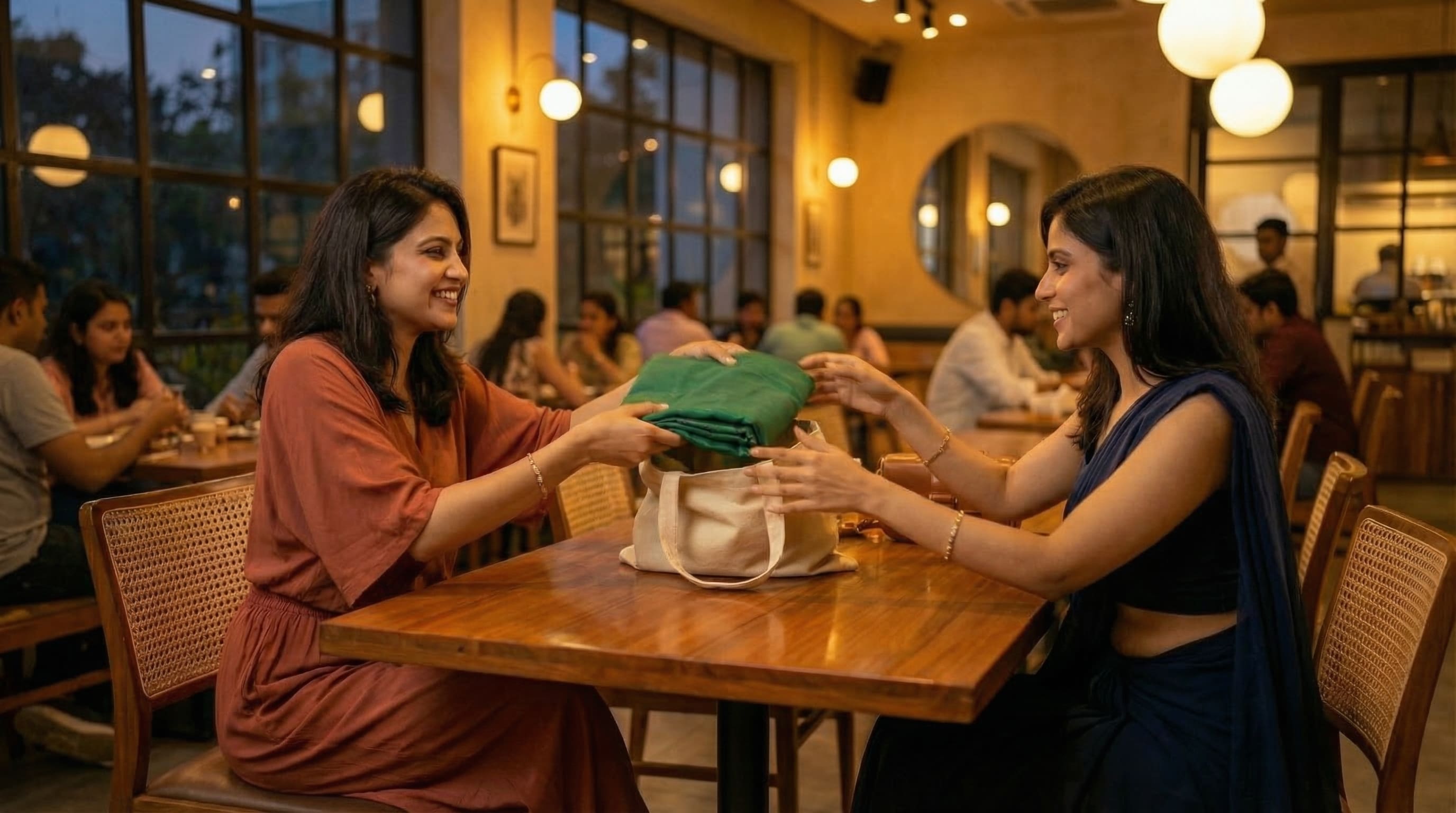
There is something in your wardrobe you would never hand to a stranger. You know exactly what it is. You don't need to think about it. The answer came to you in the first second you read that sentence.
It might be the silk saree your mother set aside for you — worth ₹40,000 and still rising. The handbag you saved three months of salary for. The embroidered stole you found at a craft fair in Kutch and have never found again since. The Raw Mango kurta you bought yourself the day you got promoted, still in its dust bag in your cupboard. Whatever it is — the feeling around it is the same. This is not for strangers.
And yet. Indian women are already the most trustworthy financial community in the world. 100 million of them, across every state, every income level, every language — lending each other money with no collateral, no paperwork, no bank guarantee. Repaying at 98%. For decades.
So the question is not whether Indian women can trust each other. They demonstrably can. The question is what creates the conditions for that trust — and whether those conditions can be built around wardrobes the way they have been built around money.
What Is a Women's Sharing Community — and Why It Is Not the Same as a Platform
A platform is a transaction. You open it, you get something, you close it. The relationship is between you and the service — its policies, its guarantees, its customer support. Trust in a platform is trust in a company.
A community is different. The relationship is between you and the other people in it. Trust in a community is trust in the people — built over time, through shared values, repeated interactions, and the knowledge that your reputation here means something. This is why Indian women trust other Indian women inside their circles in ways they never trust a stranger on an app.
This distinction matters enormously for wardrobe sharing. The reason Indian women don't lend their most valued pieces to strangers is not a technology problem. A better app does not solve it. It is a relationship problem — and relationship problems are solved by community, not by platforms.
"The SHG model has no technology advantage over banks. What it has is community — women who know each other, whose reputation is tied to their behaviour within the group. That is why the repayment rate is 98%."
As of 2024, India has 91 lakh Self Help Groups with over 10 crore women members. Their loan repayment rate is 98% — higher than most commercial banks in India — achieved with zero collateral, no credit scores, and no legal enforcement. The only guarantee is community accountability.
NABARD Annual Report, 2023-24Maahu is not building a new behaviour. It is building the infrastructure for a behaviour that Indian women have been doing inside their circles for generations — and giving it the conditions it needs to extend beyond those circles safely.
The Sharing Economy Indian Women Built Before Any App Existed
Before there were platforms, there were circles. And inside every Indian woman's circle, a sharing economy has always operated — quietly, constantly, almost invisibly.
The saree that travelled between three sisters for a decade, each one wearing it to her most important occasions and returning it without being asked. The gold earrings lent for a cousin's wedding and back in the box by Sunday night. The silk dupatta borrowed for a puja and returned washed and folded better than it left. The South Mumbai building society kitty party where twenty women pool money every month and nobody has ever defaulted — not once, not in eleven years.
This economy runs on one thing: the knowledge that the person on the other side of the exchange understands the value of what she's been trusted with. Not just the rupee value. The whole value — what it took to acquire it, what care it requires, what it would mean to lose it.
The moment the exchange goes outside that circle — to a friend of a friend, a colleague you don't know well, a stranger on an app — that knowledge disappears. And without it, the trust disappears with it.
Indian women don't have a trust problem with sharing. They have a stranger problem. The trust has always been there. The question is what creates the conditions to extend it.
The Four Fears That Stop Indian Women Sharing With Strangers
When I ask women why they won't lend their most valued pieces outside their circle, four fears come up every time. Not vague discomfort — specific, articulable fears. Here is what community does to each one.
Maahu is being built by and for women who already live this way — who lend carefully, borrow gratefully, and understand the value of what they've been trusted with.
Join the waitlist →What Indian Women Already Trust Each Other With
Here is the table I want every woman considering Maahu to sit with for a moment.
| What Indian Women Share | Inside Their Circle | On Maahu |
|---|---|---|
| Money (SHG lending) | ✓ 98% repayment | Same model, extended |
| Gold jewellery for weddings | ✓ Always returned | Community accountability |
| Heritage sarees for occasions | ✓ Returned folded | Terms agreed upfront |
| Recipes, knowledge, skills | ✓ Freely given | Shared values |
| Designer clothes with strangers | ✗ Not yet | This is what Maahu builds |
The last row is the one Maahu is writing. The repayment rate, the return rate, the reliability rate — these are numbers that will be built by the community itself, over time, through every exchange that goes exactly as it should.
Women's clothing rental and sharing accounts for 67.4% of the global market in 2024. Peer-to-peer fashion sharing platforms grew 80% year-on-year organically in 2024 — without advertising spend, driven entirely by community referrals and trust.
Allied Market Research, 2024 / Industry data, Tulerie, 2024Why Women-Only Is Not a Feature. It Is the Foundation.
Every time I describe Maahu as a women-only community, someone asks why. The question is reasonable. The answer is not about exclusion. It is about the specific conditions that make wardrobe sharing work.
The thing being shared is not just a physical object. It is something a woman chose carefully, paid for with her own money, and has a relationship with. The person it is being shared with needs to understand that — not intellectually, but instinctively, from her own experience of owning things she values.
A woman who owns a silk saree her mother gave her understands without being told what it means to lend something like that. She has felt the weight of being trusted with something precious. She knows the care it requires. She would treat your thing the way she wants her thing treated — because she has a thing.
Female DEMAT account holders in India grew from 6.67 million in 2021 to 27.71 million in 2024 — a 4.2x increase in three years. Indian women are building financial confidence and trust in new systems faster than at any point in history.
SEBI data / Economic Times, 2024Indian women are already moving rapidly into new financial systems — investing, trading, building wealth in ways their mothers didn't. The wardrobe is the next asset class. And a community of women who understand its value is the right place to start.